
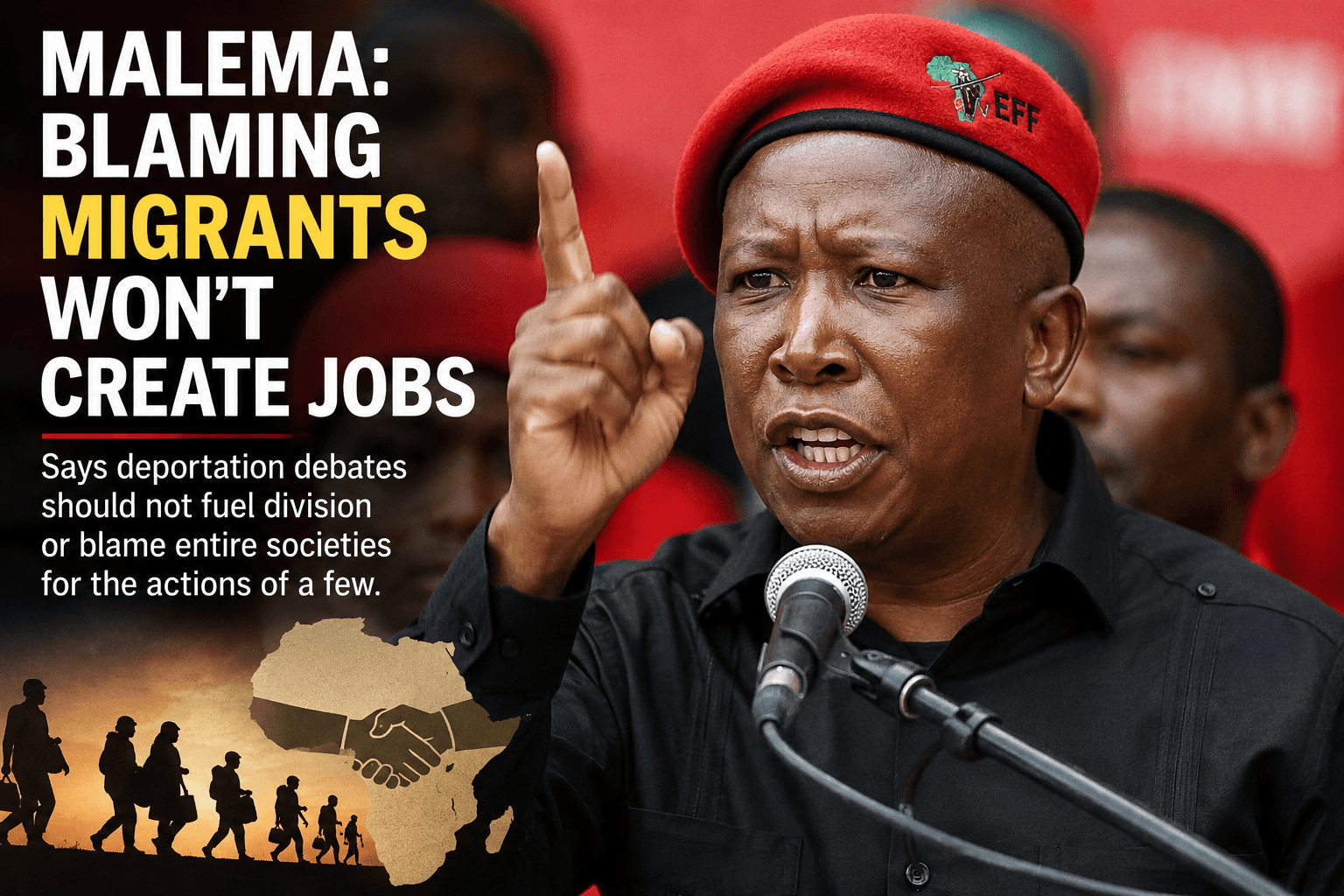
South African politician Julius Malema has spoken out strongly against rising anti-migrant narratives, warning that blaming foreign nationals for unemployment deepens division and distracts from deeper economic challenges.
His comments come amid public debate following Ghana’s evacuation of 300 nationals from South Africa, with some political and social media reactions linking migrant communities to job scarcity. Responding to such sentiments, Malema questioned the logic behind blaming migrants for unemployment, asking rhetorically: “Ghanaians are gone now, 300 of them. How many 300 jobs were created after they left?”
He argued that such thinking oversimplifies complex economic problems and risks encouraging hostility between African nations. According to him, unemployment is driven more by structural issues such as slow economic growth, inequality, and lack of industrial expansion rather than the presence of migrants.
Malema further cautioned that framing job losses around nationality can deepen what he described as “colonial divisions” within Africa, where African countries are pushed into competing against each other instead of collaborating for shared development.
He also suggested that recent discussions involving Ghanaian nationals risk unfairly generalizing entire communities based on isolated incidents or broader social frustrations. In his view, this kind of narrative can fuel xenophobia and undermine Pan-African unity.
The remarks have sparked discussion across social media, with some agreeing that migrants are often unfairly scapegoated during economic hardship, while others argue that governments must prioritize employment opportunities for their own citizens.
The debate reflects ongoing tensions in parts of Africa where migration, unemployment, and economic pressure intersect—raising broader questions about how countries can balance national interests with regional solidarity.